The Campaign Against Ash Regan’s Prostitution Bill
Scottish sex workers need your support to fight the Nordic Model!
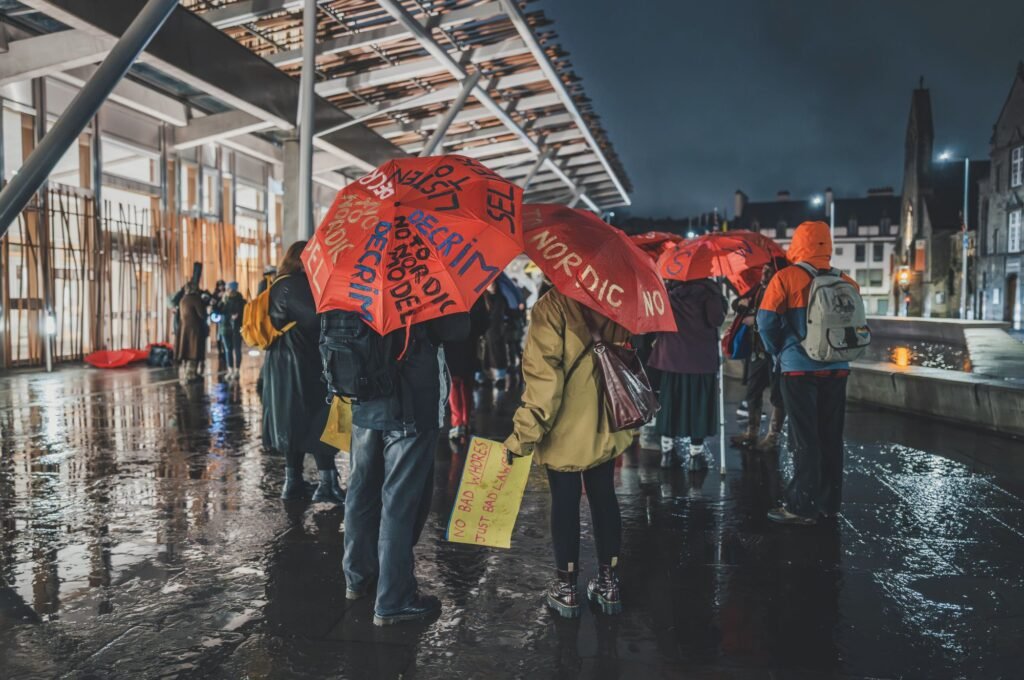
MSP Ash Regan has introduced a Bill to Scottish Parliament which would put sex workers in an even more vulnerable position by criminalising the purchase of sex (commonly referred to as the Nordic Model).
Sex workers and sex worker-led organisations don’t want this Bill – and international advocacy groups like Amensty International and the World Health Organisation all agree there is clear evidence that the Nordic Model makes sex workers less safe.
We need help from sex workers and allies to make sure the Bill doesn’t become law.
Why this matters…
Although the Bill has been framed as “protection,” evidence actually shows that increased criminalisation:
- increases violence and stigma;
- pushes workers into isolation;
- reduces trust in services;
- creates barriers to reporting harm;
- and disproportionately harms migrant, disabled, trans, and street-based workers.
We need to stop this Bill – so we’re asking allies for practical support. You do not need to be a sex worker to help. You do not need specialist knowledge or a public platform.
What we’re asking you to do…
1. Write to your MSP
MSPs are currently deciding whether to support this Bill, and direct pressure from constituents and organisations matters.
We’ve made this easy by providing a tool to help you write a letter to your MSP. Using it will only take a few minutes and makes a real difference.
Organisations, collectives, and community groups:
You can also encourage staff, members, or audiences to use the tool individually.
2. Attend MSP surgeries
The best way to influence MSPs is to attend their local surgeries, when elected officials hold opportunities to meet them face to face for a private discussion.
Contact us with your name and postcode, and we can tell you:
- who your MSPs are,
- where and when their surgeries will be,
- which of your eight MSPs are best to target for lobbying,
- and provide a policy briefing, so you can be as informed as possible.
Alternatively, you can enter your postcode on the Scottish Parliament website.
3. Donate
Stopping this Bill requires sustained, grassroots organising.
Donations support printing and campaign materials, venue hire, accessibility costs, travel for sex workers engaging with MSPs and the press and campaign infrastructure.
If you’re unable to donate, sharing the link is still meaningful support.
4. Share our resources and stay up to date
Please follow our Instagram account @scotland4decrim where we regularly post shareable graphics and videos, and share this kit with your own networks.
Asking even one person or group to take action helps grow pressure quickly.
We also run a low-pressure ally announcement board on Telegram, where we share time-limited actions, flyering calls, rapid responses and event support requests. This is not a discussion group, just occasional calls to action. Message us on Instagram for an invite.
5. Take the conversation offline
You can help build public understanding, combat misinformation and show visible opposition to the Bill by flyering in places like cafés and bookshops, libraries, education campuses, and event spaces such as community centres, studios and local venues. If you contact us we can send you physical copies.
Ash Regan, her funders and her team are misconstruing key facts about the debate – and about our campaign. Familiarise yourself with the Frequently Asked Questions below. We explain what is being proposed, and debunk some of the top myths about the Nordic model and Regan’s dangerous Bill.
Face-to-face conversations reach people that online conversations can’t.
It’s incredibly important to demonstrate opposition to this bill from real people in local communities.
Frequently Asked Questions
What are the current laws surrounding sex work in Scotland?
In Scotland and the rest of the UK, partial criminalisation makes sex work dangerous. The act of selling sex itself is not illegal, however, “associated activities” such as soliciting and brothel keeping are criminalised. This means that workers cannot work in pairs or groups for safety, and that those who do work in managed brothels have no access to workers’ rights.
For street-based and outdoor workers, soliciting in a public place and kerb-crawling (for clients) are both offences. This means there is less time for workers to engage in screening, negotiate terms and take safety measures such as informing others of their whereabouts.
Criminalisation not only makes it harder to access workers’ rights and to work safely, it also acts as a barrier to accessing justice and other forms of support. Workers are often unwilling or unable to report when they have experienced violence at the hands of a client for fear that they themselves will be criminalised, which happened to sex workers in Scotland during the Emma Caldwell investigation.
What is the Bill proposing?
The Bill would criminalise the purchase of sex under a “Nordic Model” approach, which targets clients and third parties while claiming to protect workers.
The Bill also includes a “legal right to support” for both current and former sex workers. Nordic Model advocates lean on the provision of ‘exit services’ as justification for increasing criminalisation. But in reality, these exit services are incredibly underfunded and do not meet the needs of those wishing to exit, according to the Scottish Government’s own research. In Ireland, Nordic Model supporters acknowledge that “there is no evidence that these things are in place in Ireland”.
Why are sex workers opposed to this?
It is important to note that no one currently selling sex was consulted in the drafting of this Bill. It is unthinkable in our current climate to not centre those who will be affected by the introduction of this legislation. We all deserve the right to shape our own lives.
Evidence also shows that the criminalisation of the purchase of sex would:
Increase violence
The Nordic Model means that we have to take more risks to shield those who purchase sex from police detection. We have to give more reassurance, and compromise our own plans for safety in order to continue being able to work. Instead of working with other sex workers, we are isolated and have to meet buyers in private settings – often leading to more abuse.
In a 2019 review commissioned by the Northern Irish Ministry of Justice, the policy of criminalising the purchasing of sexual services in Northern Ireland was shown to be an abject failure. Reported assaults against sex workers increased by 225% from 2016 – 2018. Evidence suggested that, while some clients were deterred by the law, dangerous, violent and abusive clients remained unaffected by the legislation. Nearly all workers interviewed felt that the law had increased the stigmatisation of sex workers in ways that made them more anxious and which had a negative impact on their day to day life.
In France, the Nordic Model has been in place since 2016. A Medicins du Monde report found that the law has led to 42% of workers being more exposed to violence, 38% finding it increasingly hard to demand condom use, 70% observing no improvement or a deterioration of their relations with the police, 78% losing income, and 63% experiencing a deterioration of living conditions. A 2018 systematic review of 28 years of global research found that any criminalisation of sex work (including client criminalisation) triples the likelihood of sex workers experiencing violence, and doubles their likelihood of acquiring HIV.
Reduce trust in police and support services
A 2020 study commissioned by HIV Ireland found that sex workers who experienced violence at work were increasingly reluctant to report to the police. Many sex workers in Scotland say they would never contact the police if they were in danger, and do not interact with support services who push the Nordic Model.
Disproportionately harms migrant, disabled, and street-based workers
Criminalising clients has been shown to increase violence for the most marginalised workers, the same workers who are often conflated with trafficking victims. Sex workers are often living with multiple forms of marginalisation: over-represented groups in sex work include women, single mothers, migrants, people of colour, disabled people, LGBT people, and people who have experienced poverty and homelessness.
Isn’t this about protecting people from exploitation?
Sex workers and human rights organisations such as Amnesty International and Human Rights Watch agree that criminalisation does not prevent exploitation. Instead, it pushes sex work underground and makes it harder for workers to work safely, seek help or report abuse.
Proponents of the Nordic Model claim that criminalising the purchase of sex will help victims of trafficking by reducing prostitution, and by extension trafficking. But trafficking isn’t caused by the demand for sex, but by people’s poverty and lack of options: people are made vulnerable to traffickers for a number of reasons. Research from Dundee and Edinburgh Napier University has shown that criminalising sex work is not an effective anti-trafficking strategy.
Isn’t it a good thing to decriminalise the sex worker?
Of course we want the removal of criminal penalties for the selling of sex, however the Bill does not fully decriminalise the worker. Amnesty International argues that, despite sex workers not being directly criminalised by the Nordic Model, it still has an impact on certain aspects of selling sex, such the use of premises to do this work in.
In countries that have brought in the Nordic Model, sex workers have not, as is often promised, been ‘decriminalised’. Brothel-keeping – which is often defined in law as two or more sex workers working together from the same premises – remains a crime, forcing women to work alone or risk arrest. When police raid workplaces with the stated aim of arresting clients, it is consistently sex workers who are charged. This has happened in Nordic Model countries such as Ireland, Norway, Finland, and Sweden.
What is Scotland for Decrim calling for instead?
Every sex worker-led organisation in the UK is calling for the full decriminalisation of sex work: a legal model which decriminalises the sex worker, the client, and third parties such as managers, drivers, and landlords.
Decriminalisation means that sex workers are able to work without threat of criminal sanctions. Criminal and administrative penalties on prostitution are repealed. Sex workers’ workplaces are regulated through employment law, enabling workers to hold their bosses to account and form trade unions.
Decriminalisation means that sex workers can work where and with whom they choose, without interference from the police, unless workers choose to call them for help. Decriminalisation allows workers to access labour law to secure their rights, improve their working conditions, and tackle exploitation and harassment. Trafficking, exploitation, coercion and violence remain illegal under full decriminalisation.
Full decriminalisation is a necessary first step on the road to keeping sex workers safe. Sex workers also demand stronger anti-poverty measures from the Scottish government, to ensure that no one is forced to resort to sex work if they don’t want to. This should include: universal access to benefits at a living wage level, proper rent controls, an end to benefit sanctions, free childcare, a complete overhaul of disability benefits, and an end to the ‘no recourse to public funds’ condition for migrants.
What should I say if someone asks me about this?
If someone is looking for more information in good faith then we hope our website and social media will be a valuable resource, and we have linked to high quality sources throughout the site for anyone who wishes to read more.
We are not asking you to engage in heated arguments, but if push-back does occur then bring it back to the safety of sex workers. In summary:
Surely, everyone’s primary concern is that those who do sex work should be as safe as they possibly can while working. Similar legislation when introduced in Northern Ireland saw a staggering 225% increase in violence towards sex workers. This Bill is based on a moralistic standpoint, rather than any evidence. It is vital that we listen to sex workers in Scotland when they say they reject this dangerous Bill.
Our Shared Values
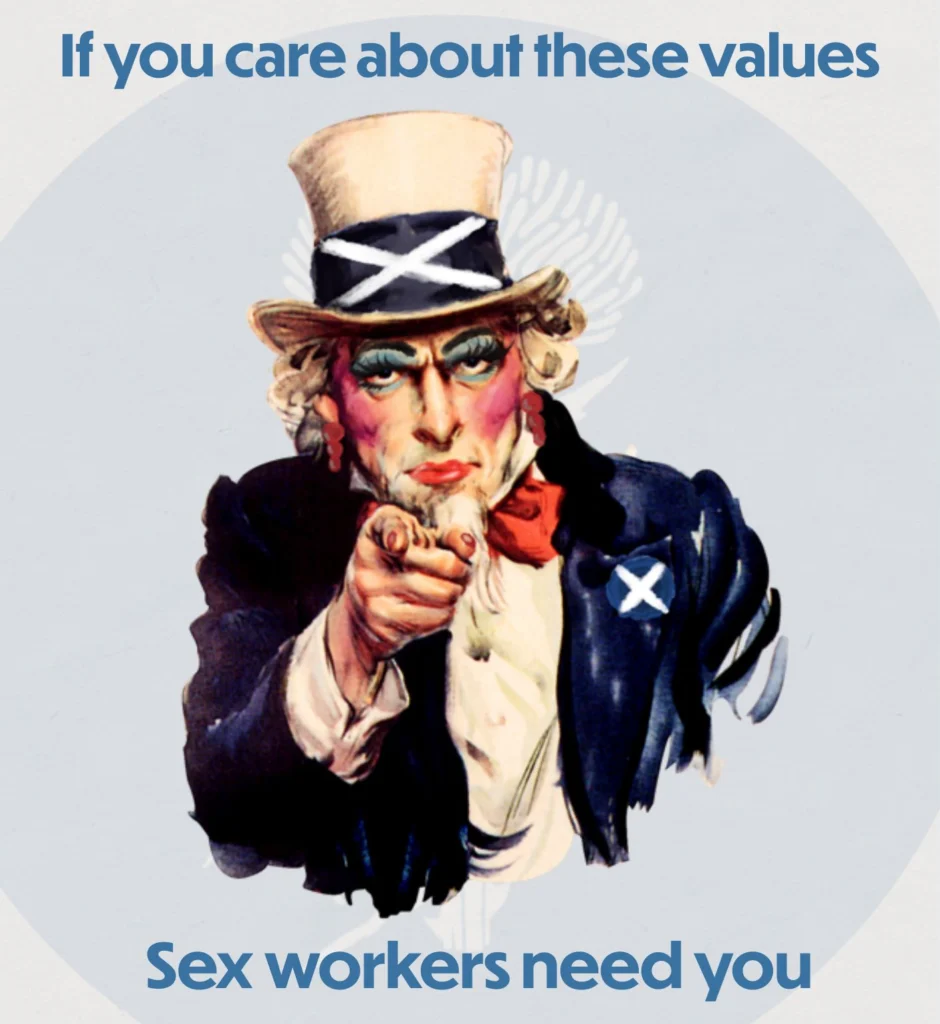
This campaign is rooted in shared commitments to:
- Anti poverty
- Bodily autonomy
- Harm reduction
- Migrant safety
- LGBTQ+ lives
- Disability justice
- Human rights